
Client Insights, October 2026
When does loyalty become a liability?
Is there an optimal length of time to stay with an employer? It's something both candidates and hiring managers place considerable importance on. Move too frequently and you risk being labelled a 'job hopper', but can staying with one employer for too long also work against you?
We recently asked our LinkedIn community what they considered the ideal length of time to stay with an employer, with some interesting results:
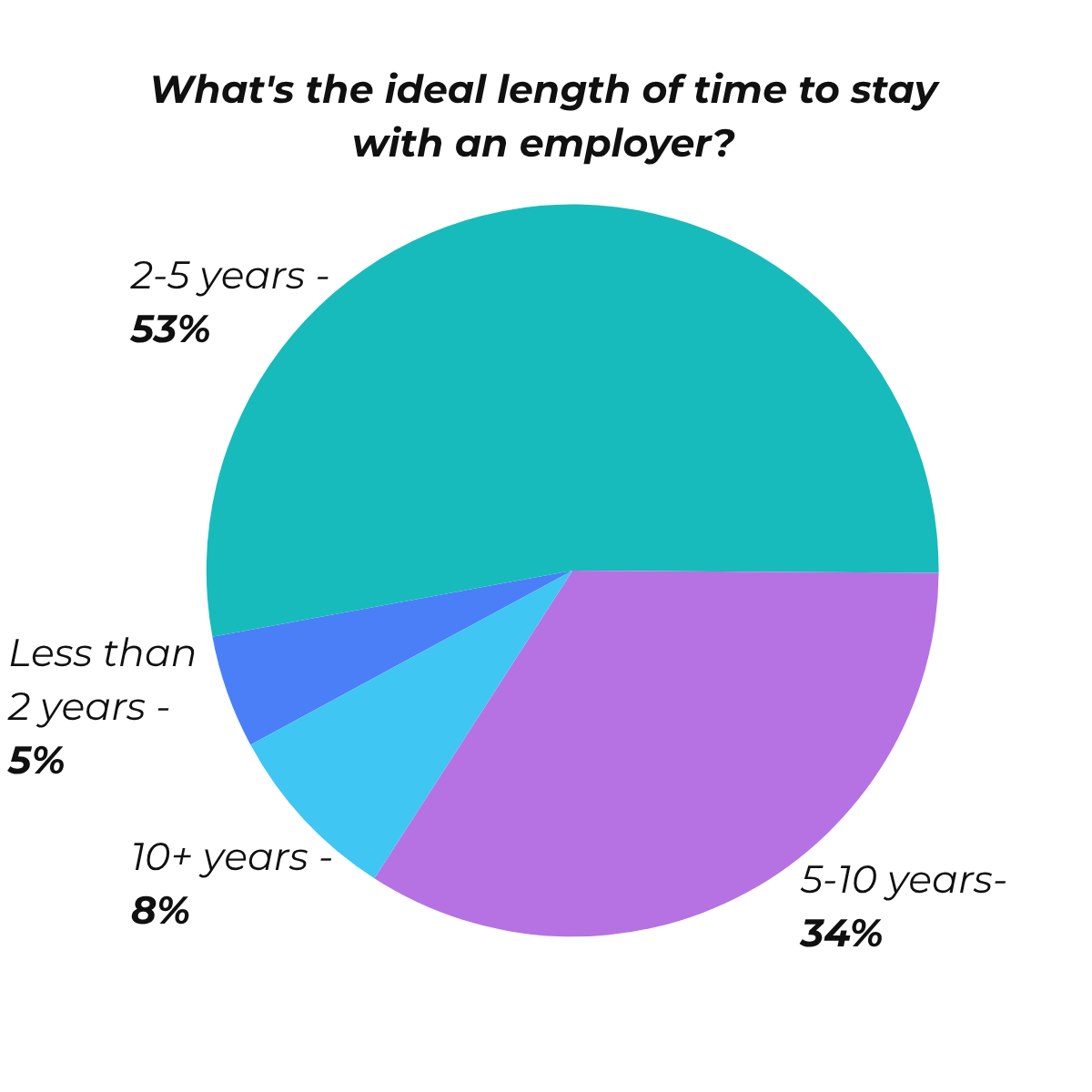
The clear favourite was 2–5 years, with 87% of respondents selecting somewhere between 2 and 10 years.
Of course, this reflects how long people think they should stay with an employer, not necessarily how long they actually do.
Is job hopping really a red flag?
A CV showing several short periods of employment can still raise concerns among hiring managers. Will the candidate stay long enough to make an impact? Are they likely to leave as soon as a better opportunity comes along? Could previous departures reflect concerns about their performance, abilities or ability to fit into a team?
Research from Ashdown Group found that around 80% of hiring managers viewed frequent job moves negatively. But there's often more to the story. Redundancies, restructures, fixed-term contracts and personal circumstances can all explain shorter tenures. And moving between employers can be a real advantage, particularly in science, where exposure to different laboratories, analytical techniques, instrumentation and research environments can broaden technical expertise and bring fresh perspectives to a team.
Perhaps the more useful question isn't simply how often has someone moved, but why did they move, and what did they gain from each experience?
Can you stay somewhere too long?
At the other end of the scale, only 8% of poll respondents selected 10+ years as the ideal tenure, suggesting that very long service isn't necessarily seen as the optimal career path. Yet the same Ashdown Group research found that approximately three-quarters of hiring managers didn't view long tenure negatively.
Long service can demonstrate loyalty, commitment and considerable depth of expertise. In highly specialised scientific disciplines, that accumulated knowledge can be particularly valuable. But spending years in a familiar environment doesn't automatically mean someone has continued to develop. Much depends on the opportunities they've had to learn, progress and take on new challenges.
And that's arguably the point. A candidate who's spent 15 years progressing through different roles with one employer may have a broader range of experience than someone who's changed companies every three years but performed essentially the same duties throughout.
Tenure tells us how long someone has stayed, but very little about what they've achieved. Whether it's nine months or nineteen years, there's always more to a candidate than the dates on their CV. And that's where a good recruiter adds value. At VRS, we take the time to speak with candidates, understand their experience, career decisions, motivations and achievements, and get the context behind what's on paper. Because there's much more to a person than their CV.
Can we help? Get in touch on hello@vrsrecruitment.com or call our friendly team on 0161 976 4000.
VRS News
This month, we were super excited to launch our NEW WEBSITE! 🎉 Designed with our scientific community in mind, it's now easier to explore our services, find scientific job opportunities and get to know the VRS team. Take a look at www.vrsrecruitment.com - we'd love your feedback!
We also enjoyed supporting ELRIG Drug Discovery 2026, offering careers advice at the MiniDD pre-conference event and helping early-career scientists navigate the challenges of securing their first industry role.
